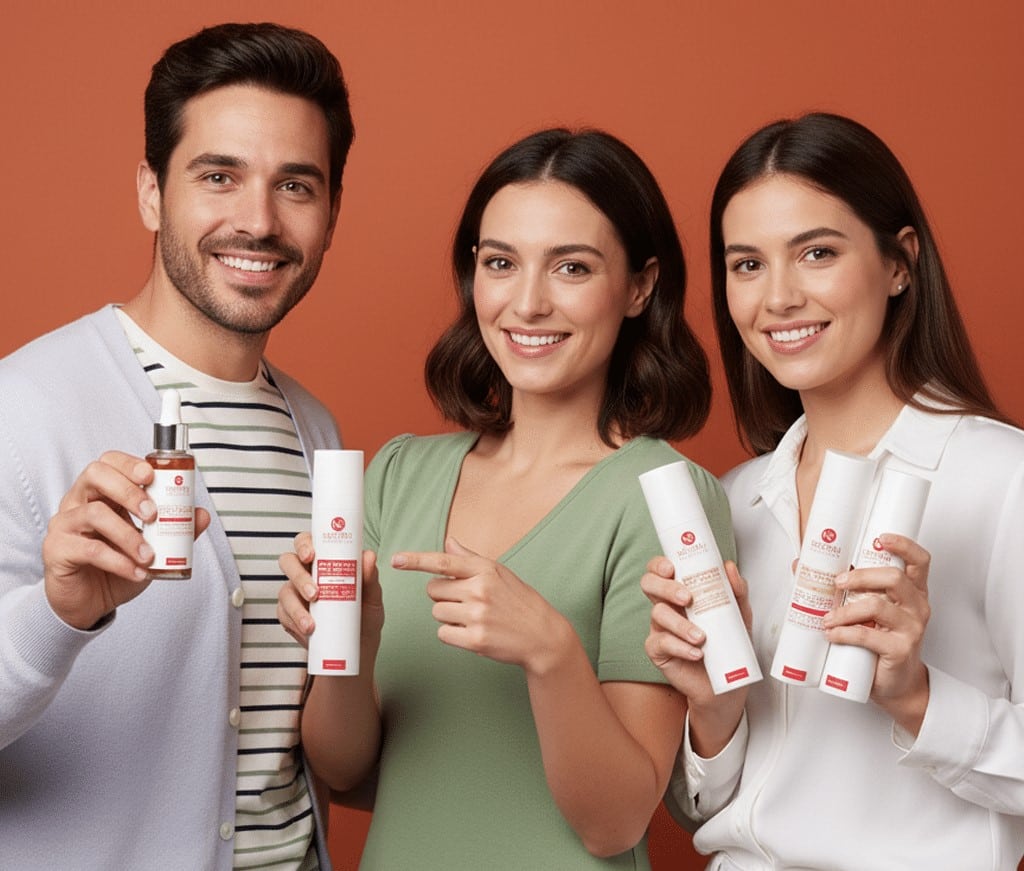

Safe preservatives, with lower exposure
What sets Nezeni apart isn’t being “preservative-free” — all cosmetics need them. What sets us apart is choosing the safest ones, at the lowest viable proportions, and compensating with a visible unopened expiry date and packaging that protects the formula.
Preservatives that are safe in the long term
We avoid the most documented sensitisers (MIT/MCI in leave-on products, long-chain parabens, free formaldehyde). We use systems with the best current dermatological profile.
As natural as possible
When the formulation allows it, well-tolerated preservatives of plant origin or synthetic-bioidentical ones. It isn’t “all natural”; it’s as natural as is viable while maintaining microbiological safety.
Safe proportions · lower exposure
We don’t use the maximum legal limit “just in case”. We use just enough to guarantee microbiological safety, certified by a mandatory challenge test on every batch.
Visible unopened expiry date
Every batch has an exact expiry date — 2 years from manufacture — printed on the product packaging. Airless PET and amber glass protect the formula from air and light, which allows us to reduce the preventive preservative load.
The essentials in 30 seconds
If you’re wondering “why Nezeni and not another brand?”, these are the facts behind it. All published, all with a verifiable citation you can check.
The core, in five sentences:
- EU regulation assesses each preservative separately. It sets individual limits (parabens 0.4%, MIT 0.0015%, etc.).
- But a person applies 9-15 products a day, with 114-168 unique ingredients (EWG 2004). Each with 4-6 preventive preservatives.
- Scientific evidence documents significant effects when several preservatives with “no observable effect” individually are combined. This is known as the cocktail effect.
- The European Commission itself acknowledges it: “substance-by-substance assessment underestimates the real risk” — COM(2012) 252 final.
- Nezeni reduces preservatives to the minimum viable level, compensating with short batches, airless/amber glass packaging and rigorous challenge testing.
What we know today · sensitisation in figures
The prevalence of contact allergy to common cosmetic ingredients is documented and has been rising over the last decade.
| Indicator | Value | Source |
|---|---|---|
| Prevalence of contact allergy in the general EU population | 27.0% | Diepgen 2016 · n=3,119 · PMID 26370659 |
| Women with contact allergy (meta-analysis) | 27.9% | Alinaghi 2019 · n=20,107 |
| Patients positive for MIT (2010-17 epidemic) | 6.0% (peak) | Schwensen 2017 · PMID 28032337 |
| Sensitisation to BIT 2014 → 2023 | 0.3% → 5.0% (×16) | Søgaard 2025 · PMID 40443262 |
| Peak MCI/MI sensitisation in Europe | 7.6% | Reeder 2023 · JAMA Dermatol |
| Women with sensitive skin (France) | 59% (2018) vs 38% (2009) | Misery 2018 · PMID 29397030 |
The cocktail effect · institutional recognition
The concept of the “cocktail effect” isn’t a brand claim — it is a position published by the European Commission itself since 2012 and backed by independent studies.
Reproduced in independent studies:
- Kortenkamp 2007 (PMID 18174953): mixtures at concentrations that individually have no observable effect produce significant effects when combined.
- Silva, Rajapakse, Kortenkamp 2002 (PMID 11999053): 8 substances, each below its no-observed-effect level, produce a significant effect when combined.
In a typical routine with 9-15 products a day, 30-50 different preservatives build up. None individually exceeds EU limits. But the combination isn’t regulated.
EU regulatory framework · regulation lags behind
Each of these regulations arrived 10-15 years after sensitisation to the restricted ingredient had increased significantly. Getting ahead of them is preventive engineering.
| Year | Regulation | Restriction |
|---|---|---|
| 2014 | Reg. (EU) 358/2014 | Ban on 5 parabens: isopropyl, isobutyl, phenyl, benzyl, pentyl |
| 2014 | Reg. (EU) 1004/2014 | Restriction of propyl/butyl parabens in children’s cosmetics |
| 2016 | Reg. (EU) 2016/1198 | Ban on MIT in leave-on products |
| 2017 | Reg. (EU) 2017/1224 | Limits MIT to 0.0015% in rinse-off products |
| 2023 | Reg. (EU) 2023/1545 | 81 allergenic fragrances to be declared in the INCI |
| 2024 | Reg. (EU) 2024/996 | Limits Retinol to 0.3% in leave-on products · Kojic Acid 1% · Alpha-Arbutin 2% · Genistein |
Nezeni’s position · three formulation decisions
Three formula decisions that anyone can check on the INCI sheet of each product.
1. Preservatives at the minimum viable level
- Every formulation passes a mandatory challenge test with the shortest possible system.
- Short batches · airless PET and amber glass packaging · strict microbiological control.
- Skin compatibility patch test as an additional check.
2. No petroleum derivatives
- We eliminate paraffinum liquidum, vaseline, mineral oil, petrolatum and derivatives.
- Replaced with plant oils (jojoba, avocado, shea, sesame, soya).
3. Visible unopened expiry date
- Every batch shows an exact unopened expiry date (not just the PAO).
- 2 years from manufacture · the date is printed on the packaging of the product you receive.
FAQs · honest questions about preservatives
4 questions we often receive about the way we formulate. We answer with verifiable data and without attacking other brands.
“They reduce preservatives to the minimum viable level. They have just enough for the product to keep well, but not the preventive ones that most brands add just in case.”
“Because when we apply cleanser, serum, eye contour cream, day and night cream, sunscreen, body lotion… each one contains 4-6 preservatives. The skin ends up receiving 30-50 different preservatives a day. European regulation assesses each one separately, but the combination isn’t regulated. The European Commission itself has acknowledged this since 2012.”
“No, they aren’t toxic individually — they comply with the law. The issue is accumulation. There are published studies showing that substances below their no-observed-effect level produce an effect when combined. This is what’s known as the cocktail effect.”
“Yes. They compensate with shorter batches, packaging that protects against contamination, and a mandatory challenge test on every batch. Microbiological safety is guaranteed — only the strategy for achieving it changes.”
Full bibliography · 15 verifiable studies
All the citations used on this page · with a direct link to PubMed or EUR-Lex so you can check them yourself.
27.0% of the European population react positively to allergens in the European baseline series.
59% of French people report having sensitive skin. Compared with 38.4% in a 2009 European sample.
6.0% of patients positive for MIT; 12.7% with generalised dermatitis; 83.2% due to exposure to cosmetics.
ESSCA Europe peak of 7.6% MCI/MI (2013-14). North America is still rising. Europe is falling after regulatory restriction.
While MIT is falling due to the ban, sensitisation to BIT rose from 0.3% (2014) to 5.0% (2023).
Cosmetic compounds persist on the skin for between 0.5 and 1.9 weeks after you stop using them.
Most molecules detectable on the skin do NOT come from the body, but from the products applied to it.
The higher the cumulative dose of a sensitiser, the lower the concentration needed for the skin to react later on.
Mixtures at concentrations that individually have “no observable effect” produce significant effects when combined.
8 substances, each below its no-observed-effect level, produce a significant effect when combined.
Skin inflammaging (chronic subclinical inflammation) breaks down collagen and elastin and accelerates wrinkles, sagging and dark spots.
Defines the “skin exposome”: UV, pollution, tobacco, diet, cosmetic products, stress.
Women have a contact allergy prevalence of 27.9%, men 13.2%. The difference is exposure, not genetics.
The average woman uses 9-15 cosmetic products a day with approx. 114-168 unique ingredients.
It acknowledges that substance-by-substance assessment underestimates the real risk because it doesn’t consider combined exposures.
The products that apply this philosophy
Short batches · preservatives at the minimum viable level · no petroleum derivatives · unopened expiry date printed on the packaging. Every Nezeni product has its full INCI on its product page — verifiable at any time.
Questions about the way we formulate? Write to us directly.